Categories

This podcast episode focuses on answering more listener questions about the Charlotte Mason method on some widely varying topics including Bible, narration, and unit studies.
Listen Now:
If you are seeing this message, please make sure you are using the most current version of your web browser: Internet Explorer 9, Firefox, Chrome


"Another point, the co-ordination of studies is carefully regulated without any reference to the clash of ideas on the threshold or their combination into apperception masses; but solely with reference to the natural and inevitable co-ordination of certain subjects. Thus, in readings on the period of the Armada, we should not devote the contemporary arithmetic lessons to calculations as to the amount of food necessary to sustain the Spanish fleet, because this is an arbitrary and not an inherent connection; but we should read such history, travels, and literature as would make the Spanish Armada live in the mind." (Vol. 3, pp. 320-21)
"English History is always with us, but only in the earliest years is it studied alone. It is not, as we know, possible always to get the ideal book, so we use the best we can find and supplement with historical essays of literary value. Literature is hardly a distinct subject, so closely is it associated with history, whether general or English; and whether it be contemporary or merely illustrative; and it is astonishing how much sound learning children acquire when the thought of an age is made to synchronise with its political and social developments. A point which I should like to bring before the reader is the peculiar part which poetry plays in making us aware of this thought of the ages, including our own. Every age, every epoch, has its poetic aspect, its quintessence, as it were, and happy the people who have a Shakespeare, a Dante, a Milton, a Burns, to gather up and preserve its meaning as a world possession...Civics takes place as a separate subject, but it is so closely bound up with literature and history on the one hand and with ethics, or, what we call every-day morals, on the other, that the division of subjects is only nominal." (Vol. 6, p. 274)

A Delectable Education, Episode 8: Narration, the Act of Knowing
Bonnie Buckingham

Charlotte Mason had two essential tools to offer children to help them regulate their own behavior. This podcast thoroughly addresses the subject that most matters in the classroom: guiding our children in acting and thinking rightly. Nicole, Liz, and Emily unfold Mason's principles of self-control, self-management, and right reasoning.
Listen Now:
If you are seeing this message, please make sure you are using the most current version of your web browser: Internet Explorer 9, Firefox, Chrome

"There are two guides to moral and intellectual self-management to offer to children, which we may call 'the way of the will' and 'the way of the reason.'" (Principle 16)
"The way of the will: Children should be taught, (a) to distinguish between 'I want' and 'I will.' (b) That the way to will effectively is to turn our thoughts from that which we desire but do not will. (c) That the best way to turn our thoughts is to think of or do some quite different thing, entertaining or interesting. (d) That after a little rest in this way, the will returns to its work with new vigour. (This adjunct of the will is familiar to us as diversion, whose office it is to ease us for a time from will effort, that we may 'will' again with added power. The use of suggestion as an aid to the will is to be deprecated, as tending to stultify and stereotype character, It would seem that spontaneity is a condition of development, and that human nature needs the discipline of failure as well as of success.)" (Principle 17)
"But there are few subjects on which those who have the education of children in their hands make more injurious mistakes [than training the will]." (Vol. 1, p. 318)
"“Your arrival at a right destination does not depend upon your choice of a good road, or upon your journeying at a good pace, but entirely upon your starting in the right direction.” (Vol. 4, p. 64)
"The way of reason: We teach children, too, not to 'lean (too confidently) to their own understanding'; because the function of reason is to give logical demonstration (a) of mathematical truth, (b) of an initial idea, accepted by the will. In the former case, reason is, practically, an infallible guide, but in the latter, it is not always a safe one; for, whether that idea be right or wrong, reason will confirm it by irrefragable proofs." (Principle 18)
"Reason, like all other properties of a person, is subject to habit and works upon the material it is accustomed to handle." (Vol. 6, p. 147)
“Perhaps we shall best use this wonderful power of reasoning, commonly called our Reason, by giving it plenty of work to do, by asking ourselves what is the cause of this and that; why do people and animals do certain things. Reason which is not worked grows sluggish; and there are persons who never wonder nor ask themselves questions about anything they see.” (Vol. 4, p. 65)

If you would like to study along with us, here are some passages from The Home Education Series and other Parent's Review articles that would be helpful for this episode's topic. You may also read the series online here, or get the free Kindle version from Fisher Academy.
Ourselves, Volume 4
Formation of Character, Volume 5, Part I, section I
An Essay Towards a Philosophy of Education, Volume 6, Book I, chapter 8-9

  |   |   |
| Anne of Green Gables, Lucy Maud Montgomery | Little Britches, Ralph Moody | The Living Page |
This Charlotte Mason podcast focuses on the subject of citizenship beyond the study of Plutarch. Are Mason's ideas about the state and the citizen outdated or irrelevant for our students today? This discussion focuses on the subject that studies government, economics, and moral responsibility in the Mason feast.
Listen Now:
If you are seeing this message, please make sure you are using the most current version of your web browser: Internet Explorer 9, Firefox, Chrome

"The honour due to our country requires some intelligent knowledge of her history, laws, and institutions; of her great men and her people; of her weaknesses and her strength; and is not to be confounded with the ignorant and impertinent attitude of the Englishman or the Chinese who believes that to be born an Englishman or a Chinese puts him on a higher level than the people of all other countries; that his own country and his own government are right in all circumstances, and other countries and other governments always wrong. But, on the other hand, still more to be guarded against, is the caitiff spirit of him who holds his own country and his own government always in the wrong and always the worse, and exalts other nations unduly for the sake of depreciating his own." (Vol. 4, Book II, p. 121)
“Children familiar with the great idea of a State in the sense, not of a government but of the people, learn readily enough about the laws, customs and government of their country; learn, too, with great interest something about themselves, mind and body, heart and soul, because they feel it is well to know what they have it in them to give to their country.” (Vol. 6, p. 187)
“It is probable that the education of the future will recognise, as its guiding idea, Matthew Arnold's fine saying, that "The thing best worth living for is to be of use." Every man and woman will be a candidate for service beyond the range of his or her own family.” (Vol. 5, p. 447)
"[In Form I] Children begin to gather conclusions as to the general life of the community from tales, fables, and the story of one or another great citizen." (Vol. 6, p. 185)
"[In Form II] Citizenship becomes a definite subject rather from the point of view of what may be called the inspiration of citizenship than from that of the knowledge proper to a citizen, though the latter is by no means neglected." (Vol. 6, p. 185)
“There are few better equipments for a citizen than a mind capable of discerning the Truth, whether it lie on the side of our party or on that of our opponents. But this just mind can only be preserved by those who take heed what they hear, and how.” (Vol 4, p. 154)
"Civics takes place as a separate subject [from history], but it is so closely bound up with literature and history on the one hand and with ethics, or, what we call every-day morals, on the other, that the division of the subjects is only nominal." (Vol. 6, p. 274)
If you would like to study along with us, here are some passages from The Home Education Series and other Parent's Review articles that would be helpful for this episode's topic. You may also read the series online here, or get the free Kindle version from Fisher Academy.
Ourselves (Volume 4)
Towards a Philosophy of Education (Volume 6), pp. 185-189
The Citizen Reader (Used by Mason in the PNEU, Form 2)
Uncle Eric series by Richard Maybury
Gerald Johnson's Books on the government: The Presidency, The Cabinet, The Congress, The Supreme Court
(Contains affiliate links)
Audio Version of Charlotte Mason's Ourselves (Volume 4)
Nancy Kelly is an experienced Charlotte Mason teacher who joins us on this podcast to discuss the teaching of Plutarch. You will enjoy her helpful tips and inspiring wisdom.
Listen Now:
If you are seeing this message, please make sure you are using the most current version of your web browser: Internet Explorer 9, Firefox, Chrome

"We take the child to the living sources of history––a child of seven is fully able to comprehend Plutarch, in Plutarch's own words (translated), without any diluting and with little explanation." (Vol. 2, p. 278)
If you would like to study along with us, here are some passages from The Home Education Series and other Parent's Review articles that would be helpful for this episode's topic. You may also read the series online here, or get the free Kindle version from Fisher Academy.
Parents and Children (Volume 2), pp. 278-79
  |   |   |
| Loomis translation (For Teacher Prep) | North's Plutarch (Heritage Press Edition) | Stories from the History of Rome |
  |   | |
| Fifty Famous Stories Retold | Nancy's Favorite Retelling |
(Contains affiliate links)
Anne White's Study Guides (free online--scroll down to individual Lives listings)
Nancy's 3-Part Blog series on Plutarch
The Great Courses on Plutarch

Charlotte Mason thought Plutarch an invaluable source of knowledge and moral wisdom in the subject of citizenship. This podcast explores who he was, why Mason thought so, and how the study of the lives he described would inform and enrich our children.
Listen Now:
If you are seeing this message, please make sure you are using the most current version of your web browser: Internet Explorer 9, Firefox, Chrome

“In the same way, readings from Plutarch's Lives will afford the best preparation for the study of Grecian or of Roman history.” (Vol. 1, p. 286)
“[T]he principle being, that, whenever practicable, the child should get his first notions of a given period, not from the modern historian, the commentator and reviewer, but from the original sources of history, the writings of contemporaries.” (Vol. 1, p. 285)
“Perhaps nothing outside of the Bible has the educational value of Plutarch’s Lives.” (Vol. 3, p. 236)
“[The Lives] stand alone in literature as teaching that a man is part of the State, that his business is to be of service to the State, but that the value of his service depends upon his personal character.” (Vol. 3, p. 280)
“...an early education from the great books with the large ideas and the large virtues is the only true foundation of knowledge--the knowledge worth having.” (Vol. 6, p. 308)
"We take the child to the living sources of history––a child of seven is fully able to comprehend Plutarch, in Plutarch's own words (translated), without any diluting and with little explanation." (Vol. 2, p. 278)
“We read him his Tanglewood Tales, and when he is a little older his Plutarch, not trying to break up or water down, but leaving the child's mind to deal with the matter as it can.” (Vol. 2, pp. 231-232)
“[Plutarch] hath written the profitable story of all authors. For all other were fain to take their matter, as the fortune of the countries whereof they wrote fell out: But this man being excellent in wit, learning, and experience, hath chosen the special acts of the best persons, of the famousest nations of the world.” (Thomas North as quoted by Mason in Vol. 6, p. 274)
If you would like to study along with us, here are some passages from The Home Education Series and other Parent's Review articles that would be helpful for this episode's topic. You may also read the series online here, or get the free Kindle version from Fisher Academy.
Home Education (Volume 1), pp. 286-87
School Education (Volume 3), pp. 152, 235, 280-81, 286-89
Ourselves (Volume 4), Book I, Chapter 2
Towards a Philosophy of Education (Volume 6), Book I, Section II, "Morals and Economics"


(Contains affiliate links)
Stories from the History of Rome (free online)
Anne White's Study Guides (free online--scroll down to individual Lives listings)
The Children's Plutarch (free online)
Weston's Plutarch (free online)
Kaufman's Plutarch (free online)

Charlotte Mason's education is not just for children. This podcast is a discussion of three mothers who have found that Mason has influenced them in ways they never could have dreamed when they took up her methods. Listen to discover all the ways the delectable feast can nourish you, the teacher.
Listen Now:
If you are seeing this message, please make sure you are using the most current version of your web browser: Internet Explorer 9, Firefox, Chrome

"The mother cannot devote herself too much to [nature] reading, not only that she may read tit-buts to her children about matters they have come across, but that she may be able to answer their queries and direct their observations. And not only the mother, but any woman who is likely ever to spend an hour or two in the society of children, should make herself mistress of this sort of information; the children will adore her for knowing what they want to know, and who knows but she may give its bent for life to some young mind designed to do great things for the world." (Vol. 1, pp. 64-65)
Find a Charlotte Mason group in your area
Find a Charlotte Mason Retreat in your area
Charlotte Mason Institute National Conferences
Charlotte Mason Institute Regional Conferences
Other Charlotte Mason Endeavors Near You
Grace to Build Retreat
Living Education Retreat
CM West Retreat
More Upcoming CM Conferences on the West Coast
Simply Charlotte Mason Seminars
Audio Download of Liz's Plenary at Grace to Build Retreat last year: "Mothers: The Living Books Our Children Read"
Charlotte Mason Institute Collaborative Blog
Fisher Academy Blog
Charlotte Mason Blog Carnival Link Up
Sage Parnassus

This podcast addresses common questions that arise as parents and teachers pursue knowledge of the Charlotte Mason method. Whether specific small questions, or large philosophic ones, they are common to most of us and Nicole, Emily and Liz attempt to draw from the deep well of Mason's own writings, as well as their experience in applying that wisdom, to meet the most frequent perplexities head on.
Listen Now:
If you are seeing this message, please make sure you are using the most current version of your web browser: Internet Explorer 9, Firefox, Chrome

  |   |   |
| The Phantom Tollbooth, Norman Juster | The 21 Balloons, William Pene du Bois | My Side of the Mountain, Jean Craighead George |
  |   |   |
| Old Yeller, Fred Gipson | Where the Red Fern Grows, Wilson Rawls | Harry Potter Series, J.K. Rowling |
  |   |   |
| Rascal, Sterling North | Deathwatch, Robb White | Read-Aloud Handbook, Jim Trelease |
 | ||
| The Living Page, Laurie Bestvater |
Scale How Meditations (see page 49 for quote discussed)
A Delectable Education, Episode 4: Education is an Atmosphere, a Discipline, a Life
Charlotte Mason is extraordinary in the arts and humanities, but does her method really work for science, especially in an age when science is king? This podcast will address all the aspects of teaching science that put most average parents in a panic at the high school level and you will find yourself eager to get on with it.
Listen Now:
If you are seeing this message, please make sure you are using the most current version of your web browser: Internet Explorer 9, Firefox, Chrome
"Our aim in Education is to give a Full Life.––We begin to see what we want. Children make large demands upon us. We owe it to them to initiate an immense number of interests. Thou hast set my feet in a large room; should be the glad cry of every intelligent soul. Life should be all living, and not merely a tedious passing of time; not all doing or all feeling or all thinking––the strain would be too great––but, all living; that is to say, we should be in touch wherever we go, whatever we hear, whatever we see, with some manner of vital interest. We cannot give the children these interests; we prefer that they should never say they have learned botany or conchology, geology or astronomy. The question is not,––how much does the youth know? when he has finished his education––but how much does he care? and about how many orders of things does he care? In fact, how large is the room in which he finds his feet set? and, therefore, how full is the life he has before him?" (Vol. 3, pp. 170-71)
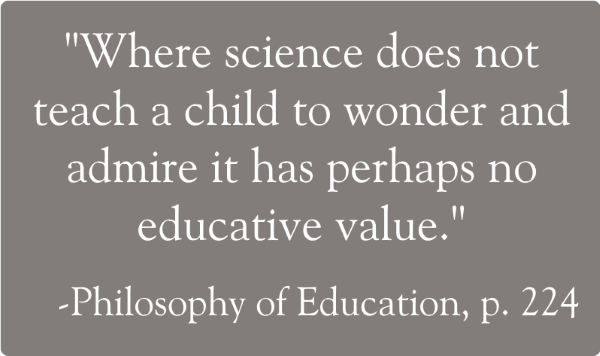
“Where science does not teach a child to wonder and admire it has perhaps no educative value.” (Vol. 6, p. 224)
"Geology, mineralogy, physical geography, botany, natural history, biology, astronomy––the whole circle of the sciences is, as it were, set with gates ajar in order that a child may go forth furnished, not with scientific knowledge, but with, what Huxley calls, common information, so that he may feel for objects on the earth and in the heavens the sort of proprietary interest which the son of an old house has in its heirlooms." (Vol. 3, p. 79)
“The essential mission of school science was to prepare pupils for civilised citizenship by revealing to them something of the beauty and the power of the world in which they lived, as well as introducing them to the methods by which the boundaries of natural knowledge had been extended. School science, therefore, was not intended to prepare for vocations, but to equip pupils for life. It should be part of a general education, unspecialised, in no direct connexion with possible university courses to follow.” (Sir Richard Gregory, quoted by Charlotte Mason in Vol. 6, p. 222)
"So much attention is now given to the practical and systematic study of science in schools that the valuable influence of descriptive scientific literature is apt to be overlooked. An intimate knowledge of the simplest fact in nature can be obtained only through personal observation or experiment in the open air or in the laboratory, but broad views of scientific thought and progress are secured best from books in which the methods and results of investigation is stated in language that is simple without being childish.
"Books intended to promote interest in science must differ completely from laboratory guides, textbooks, or works of reference. They should aim at exalting the scientific spirit which leads men to devote their lives to the advancement of natural knowledge, and at showing how the human race eventually reaps the benefit of such research. Inspiration rather than information should be the keynote; and the execution should awaken in the reader not only appreciation of the scientific method of study and spirit of self sacrifice, but also a desire to emulate the desires of men whose labors have brought the knowledge of nature to its present position." (From The Wonders of Physical Science by Edward Fourlier, used in PNEU)

 The Mystery of the Periodic Table
 For the Love of Physics
(Contains affiliate links)
Read-Aloud Revival Episode with Dr. Pakaluk
Nicole's Website with loads of information on living CM science
*NEW Living Science Study Guides--Nicole guides us through a term or year of Middle School Biology
Keeping a Science Notebook
Living Science Ideas scroll down for a subject by subject list of living books
This podcast episode explores the ideas and objectives Charlotte Mason considered necessary for the study of science for grades 1-6. Listen to hear clear guidelines to follow, book suggestions, and practical applications for teaching science.
Listen Now:
If you are seeing this message, please make sure you are using the most current version of your web browser: Internet Explorer 9, Firefox, Chrome
If you would like to study along with us, here are some passages from The Home Education Series and other Parent's Review articles that would be helpful for this episode's topic. You may also read the series online here, or get the free Kindle version from Fisher Academy.
Home Education (Volume 1), Part V, Chapter XVI
School Education (Volume 3), Chapter 21, Part II
Towards a Philosophy of Education (Volume 6), Book I, Chapter 10, Section III




(Contains affiliate links)
Nicole's Elementary Science Page at SabbathMoodHomeschool.com
Charlotte Mason did not consider nature study to be optional. This podcast is an interview with a mother with eight children who took Mason's words to heart and exerted the effort to make it happen. Listen to her experiences and practical hints for being a successful mother of young naturalists.
Listen Now:
If you are seeing this message, please make sure you are using the most current version of your web browser: Internet Explorer 9, Firefox, Chrome

"I venture to suggest, not what is practicable in any household, but what seems to me absolutely best for the children; and that, in the faith that mothers work wonders once they are convinced that wonders are demanded of them." (Vol. 1, p. 44)
"We were all meant to be naturalists, each in his degree, and it is inexcusable to live in a world so full of the marvels of plant and animal life and to care for none of these things." (Vol. 1, p. 61)
"Our P.N.E.U. Natural History Club"
"Natural History Club"
"P.N.E.U. Natural History Clubs"
"The Educational Value of Natural History"
Charlotte Mason Institute National Conference
Grace to Build Retreat
This podcast episode explains Charlotte Mason's use of nature lore books and how they expand outdoor nature study work. Listen for lots of hints of our favorite such books.
Listen Now:
If you are seeing this message, please make sure you are using the most current version of your web browser: Internet Explorer 9, Firefox, Chrome
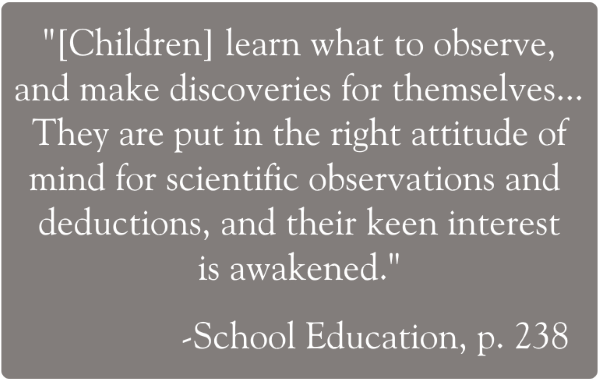
"Our main dependence is on books as an adjunct to out-of-door work...In [these] books the children are put in the position of the original observer of biological and other phenomena. They learn what to observe, and make discoveries for themselves, original so far as they are concerned. They are put in the right attitude of mind for scientific observations and deductions, and their keen interest is awakened." (Vol. 3, p. 237
"The real use of naturalists' books is to give the child delightful glimpses into the world of wonders he lives in, reveal the sorts of things to be seen by curious eyes, and fill him with desire to make discoveries for himself." (Vol. 1, p. 64)
If you would like to study along with us, here are some passages from The Home Education Series and other Parent's Review articles that would be helpful for this episode's topic. You may also read the series online here, or get the free Kindle version from Fisher Academy.
The Charm of Nature Study, Parents' Review Article

 Eyes and No Eyes Series, Arabella Buckley or online here.
 Madam How and Lady Why, Charles Kingsley or online here.
 Life and Her Children, Arabella Buckley
 The Storybook of Science, Jean Henri Fabre or online here.
 Winners in Life's Race, Arabella Buckley or online here.
 We Were There with Charles Darwin on the H.M.S. Beagle, Philip Eisenberg
 Pilgrim at Tinker Creek, Annie Dillard
 John Muir Books
 John Burroughs
 Autumn Across America, Edwin Way Teale
 Life of the Spider, Jean Henri Fabre
 The Evolution of Calpurnia Tate, Jacqueline Kelly
 The Grasshopper Book, Wilfrid Bronson
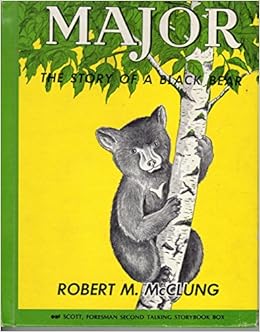
 Robert McClung Books
 Olive Earle Books
 Millicent Selsam Books
 Charles Ripper Books
 Alice Goudey Books
 Girl of the Limberlost, Gene Stratton-Porter
 The Keeper of the Bees, Gene Stratton-Porter
 A Sand County Almanac, Aldo Leopold
 William Long Books
 Treasury for Children, James Herriot
 All Creatures Great and Small, James Herriot
 Rascal, Sterling North
(Contains affiliate links)
This podcast episode explores the reasons Charlotte Mason gave for the necessity of a child's education to include a vast familiarity with the outside world. Beyond discussing why nature study is critical to knowledge of God, the benefits to personal growth, and its fundamental effects on future academic success, many practical suggestions for accomplishing this essential study are discussed to encourage your family's implementation of and regular involvement in nature study.
Listen Now:
If you are seeing this message, please make sure you are using the most current version of your web browser: Internet Explorer 9, Firefox, Chrome
"We were all meant to be naturalists, each in his degree, and it is inexcusable to live in a world so full of the marvels of plant and animal life and to care for none of these things." (Vol. 1, p. 61)
"When children are old enough to understand that science itself is in a sense sacred, and demands some sacrifice, all the common information they have been gathering until then, and the habits of observation they have acquired, will form an excellent ground work for a scientific education. In the meantime let them consider the lilies of the field and fowls of the air." (Vol. 1, p. 63)
"Consider, too, what an unequalled mental training the child-naturalist is getting for any study or calling under the sun––the powers of attention, of discrimination, of patient pursuit, growing with his growth, what will they not fit him for? Besides, life is so interesting to him, that he has no time for the faults of temper which generally have their source in ennui; there is no reason why he should be peevish or sulky or obstinate when he is always kept well amused." (Vol. 1, pp. 61-62)
"Never be within doors when you can rightly be without." (Vol. 1, p. 42)
"The first buttercup in a child's nature note book is shockingly crude, the sort of thing to scandalize a teacher of brush-drawing, but by and by another buttercup will appear with the delicate poise, uplift and radiance of the growing flower." (Vol. 6, p. 217)
If you would like to study along with us, here are some passages from The Home Education Series and other Parent's Review articles that would be helpful for this episode's topic. You may also read the series online here, or get the free Kindle version from Fisher Academy.
Home Education (Volume 1), Part II
School Education (Volume 3), pp. 236-238
"The Charm of Nature Study" by G. Dowton, an article from the Parent's Review

 The Handbook of Nature Study, Anna Comstock
 The Last Child in the Woods, Richard Louv
(Contains affiliate links)
Charlotte Mason Digital Collection
Nature Journal Examples {Here}, {Here}, and {Here}
John Muir Laws' Nature Journaling site
Examples of Bird and Flower Lists
PR Article on the benefits to language from Nature Study

Our discussions on the subject of history resulted in an onslaught of questions. This podcast episode slowly and carefully addresses the most common and frequently asked history concerns, misunderstandings, and points of confusion we have received about Charlotte Mason's approach to teaching this subject.
Listen Now:
If you are seeing this message, please make sure you are using the most current version of your web browser: Internet Explorer 9, Firefox, Chrome

"We introduce children as early as possible to the contemporary history of other countries as the study of English history alone is apt to lead to a certain insular and arrogant habit of mind." (Vol. 6, p. 175)
"The flowers, it is true, are not new; but the children are; and it is the fault of their elders if every new flower they come upon is not to them a Picciola, a mystery of beauty to be watched from day to day with unspeakable awe and delight." (Vol.1, p.53)


 The Story of Edith Cavell, Iris Vinton
(Contains affiliate links)

Check out Leah Boden's Periscope, The Charlotte Mason Show
The scope of the subject of geography matches the size of the world it covers and Charlotte Mason's approach to this subject is likewise vast and multifaceted. This podcast episode discusses the purpose of geography study, the variety of resources used for learning, and gives a broad overview of the progression throughout forms I to VI.
The Bible is the most authoritative and ancient of all books and Mason considered its lessons to be the supreme lesson, leading most directly to knowledge of God. This podcast explores why she was of this opinion, why we must not neglect its lessons, and how those lessons should be presented.

Since it's impossible to cover every aspect of a subject each week, questions arise in our listeners' minds. Many of you are sending us your questions and in this podcast we attempt to thoroughly answer a few of these based on the wisdom of Charlotte Mason and our experience in using her method. This is the first of several sporadic Q&A sessions we will post.
Listen Now:
If you are seeing this message, please make sure you are using the most current version of your web browser: Internet Explorer 9, Firefox, Chrome


 The March of Folly, Barbara Tuchman
 Hannah Coulter, Wendell Berry
(Contains affiliate links)
Living Books Library's Book Sale Pages
List of living books libraries around the country
Another list of living books libraries
Ten Books you can read in Ten Minutes a Day
Liz's Annual List of Books She Read
Beyond the books, what are some tools that are useful in putting history into living color for a child? At what age should we begin to use a timeline, or should we use a timeline at all? How do we implement the book of centuries? Listen in as we wrestle with some of the things that make history lessons come alive.
Listen Now:
If you are seeing this message, please make sure you are using the most current version of your web browser: Internet Explorer 9, Firefox, Chrome

If you would like to study along with us, here are some passages from The Home Education Series and other Parent's Review articles that would be helpful for this episode's topic. You may also read the series online here, or get the free Kindle version from Fisher Academy.
Home Education (Volume 1), pg. 292
Towards a Philosophy of Education (Volume 6), pg. 177
Miss Beale's Parents' Review Article on "The Teaching of Chronology"
Parents' Review Article on making and keeping a Book of Centuries

(Contains affiliate links)

Laurie Bestvater's Book of Centuries
Another Book of Centuries from Riverbend Press
Bernau's Article on the Book of Centuries With much gratitude to the Charlotte Mason Institute for making this PDF available
Beale's Article on the Teaching of Chronology With much gratitude to the Charlotte Mason Institute for making this PDF available
H.B.'s Article on the Teaching of History With much gratitude to the Charlotte Mason Institute for making this PDF available
Biggar's Article on How to Make a Century Chart With much gratitude to the Charlotte Mason Institute for making this PDF available
When we are clear in the direction we are headed in our children's history studies, know the time period and the order and the streams to cover, what books will we use to explore those unfathomable numbers of events and characters in history? Is a spine necessary? What is the real value of a biography? How much should we be concerned about the historical accuracy of the account we are reading? Explore these ideas with us in this episode.
Listen Now:
If you are seeing this message, please make sure you are using the most current version of your web browser: Internet Explorer 9, Firefox, Chrome
"[B]ut let the mother beware: there is nothing which calls for more delicate tact and understanding sympathy with the children than this apparently simple matter of choosing their lesson-books, and especially, perhaps, their lesson-books in history." (Vol. 1, pg. 289)
"We know that young people are enormously interested in the subject and give concentrated attention if we give them the right books." (Vol. 6, pg. )
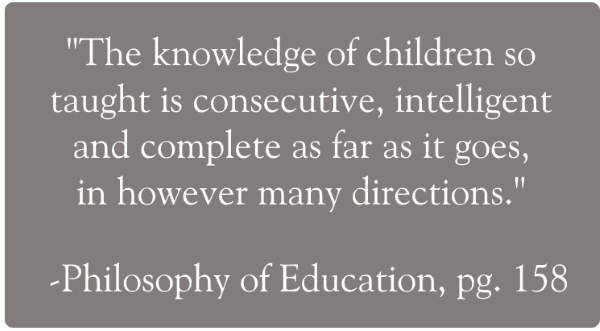
"The knowledge of children so taught is consecutive, intelligent and complete as far as it goes, in however many directions." (Vol. 6, pg. 158)
"In Form IV the children are promoted to Gardiner's Student's History of England, clear and able, but somewhat stiffer than that they have hitherto been engaged upon." (Vol. 6, pg. 176)
"Of all the pleasant places in the world of mind, I do not know that any are more delightful than those in the domain of History. Have you ever looked through a kinetoscope? Many figures are there, living and moving, dancing, walking in procession, whatever they happened to be doing at the time the picture was taken. History is a little like that, only much more interesting, because in these curious living photographs the figures are very small and rather dim, and most attentive gazing cannot make them clearer; now, History shows you its personages, clothed as they were clothed, moving, looking, speaking, as they looked, moved, and spoke, engaged in serious matters or in pleasures; and, the longer you look at any one person, the more clearly he stands out until at last he may become more real to you than the people who live in your own home." (Vol. 4, pg. 36)
"The fatal mistake is in the notion that he must learn 'outlines,' or a baby edition of the whole history of England, or of Rome, just as he must cover the geography of all the world. Let him, on the contrary, linger pleasantly over the history of a single man, a short period, until he thinks the thoughts of that man, is at home in the ways of that period. Though he is reading and thinking of the lifetime of a single man, he is really getting intimately acquainted with the history of a whole nation for a whole age." (Vol. 1, pg. 280)
"Literature is dangerous--except when taken in large doses." --Martin Cothran (quoted here.)


America Grows Up (Volume 2)
America Moves Forward (Volume 3)


(Contains affiliate links)

A wonderful resource with reviews of living books series, See especially Messner Biographies, Signature Series, Garrard History Series Books, and Landmark Books

Merry Christmas! As we celebrate the coming of our Savior, Jesus Christ, we took a break from discussing history to bring you a special episode. Art Middlekauff shares with us a lesser-known, but very important work by Charlotte Mason herself--her poetic reflections on the Life of Christ entitled, The Saviour of the World. We hope this episode, and more importantly, these poems, will bless you and yours today and in the year to come.
Listen Now:
If you are seeing this message, please make sure you are using the most current version of your web browser: Internet Explorer 9, Firefox, Chrome

You can find Art Middlekauff's blog here
The Savior of the World (online)
Hardback reprints of Volumes 1, 3, 4, and 5
Paperback reprints of Volumes 1, 2, and 3
This post describes an app to read an online Bible with links to the corresponding Saviour of the World Poems
In Memorium

In Mason's day, the subject of history was covered differently from our common approaches to that subject today. How do the records show she managed the study of ancient through modern history in all the age levels? More important, how can we follow her principles and keep history study relevant to our day? Emily, Nicole, and Liz attempt to distill these truths in an orderly conversation that will reveal a rich feast of history for a child.
Listen Now:
If you are seeing this message, please make sure you are using the most current version of your web browser: Internet Explorer 9, Firefox, Chrome
"The early history of a nation is far better fitted than its later records for the study of children, because the story moves on a few broad, simple lines.” (Vol. 1, pg. 281)
“We are not content that they should learn the history of their own country alone; some living idea of contemporaneous [meaning existing or occurring in the same period of time] European history, anyway, we try to get in; that the history we teach may be the more living, we work in, pari passu [meaning side by side; at the same pace], some of the literature of the period and some of the best historical novels and poems that treat of the period; and so on with other subjects.” (Vol. 3, pg. 67)
History Rotation Diagrams we at A Delectable Education have put together to clarify the rotations and "streams" of history study through the school forms
Charlotte Mason Digital Collection
Sample "Forms" Schedule from the P.N.E.U.

The subject of history brings groans to some and yawns to others, but Mason considered it the pivotal subject in her curriculum. Listen in as these moms discuss some of Charlotte Mason's beliefs about the teaching of history and why it is centrally important to the subjects that give the "Knowledge of Man" and provides much, much more than a knowledge of dates and facts of wars and famous events.
Listen Now:
If you are seeing this message, please make sure you are using the most current version of your web browser: Internet Explorer 9, Firefox, Chrome
"Next in order to religious knowledge, history is the pivot upon which our curriculum turns." (Vol. 6, p. 273)
"But to read English history and fail to realise that it is replete with interest, sparkling with episode, and full of dramatic incident, is to miss all the pleasure and most of the instruction which its study, if properly pursued, can give." (vol. 1, pp. 290-91)
“[H]istory is an entrancing subject of study,” (Vol. 1, p. 292)
"[I]t seems to be necessary to present ideas with a great deal of padding, as they reach us in a novel or poem or history book written with literary power." (Vol. 6, p. 109)
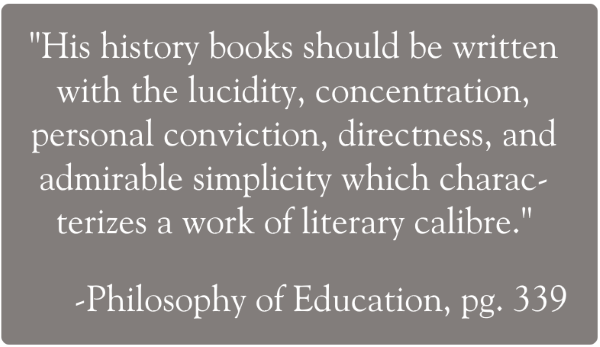
"For the matter for this intelligent teaching of history, eschew, in the first place, nearly all history books written expressly for children; and in the next place, all compendiums, outlines, abstracts whatsoever." (Vol. 1, p. 281)
"[O]ut of a whole big book he may not get more than half a dozen of those ideas upon which his spirit thrives; and they come in unexpected places and unrecognised forms, so that no grown person is capable of making such extracts from Scott or Dickens or Milton, as will certainly give him nourishment. It is a case of,––'In the morning sow thy seed and in the evening withhold not thine hand for thou knowest not whether shall prosper, either this or that.' [Eccl. 11:6]" (Vol. 6, pp. 109-110)
“Now imagination does not descend, full grown, to take possession of an empty house; like every other power of the mind, it is the merest germ of a power to begin with, and grows by what it gets; and childhood, the age of faith, is the time for its nourishing. The children should have the joy of living in far lands, in other persons, in other times––a delightful double existence; and this joy they will find, for the most part, in their story books. Their lessons, too, history and geography, should cultivate their conceptive powers. If the child do not live in the times of his history lesson, be not at home in the climes of his geography book describes, why, these lessons will fail of their purpose.” (Vol. 1, p. 153)
"It is a great thing to possess a pageant of history in the background of one's thoughts." (Vol. 6, p. 178)
"To us in particular who are living in one of the great epochs of history it is necessary to know something of what has gone before in order to think justly of what is occurring to-day." (Vol. 6, p. 169)
"It is not too much to say that a rational well-considered patriotism depends on a pretty copious reading of history, and with this rational patriotism we desire our young people shall be informed rather than with the jingoism of the emotional patriot." (Vol. 6, p. 170)
"[A]void giving children cut-and-dried opinions upon the course of history while they are yet young." (Vol. 1, p. 288)
"I will not press my point by urging the moral bankruptcy which has been exposed to us during recent years as co-existent with, if not caused by, utilitarian education." (Vol. 6, pp. 282-83)
“He who reads history in this way, not to pass examinations, nor to obtain culture, nor even for his own pleasure (delightful as such reading is), but because he knows it to be his duty to his country to have some intelligent knowledge of the past, of other lands as well as of his own, must add solid worth to the nation that owns him.” (Vol. 4, pp. 74-75)
"[T]hat the history we teach may be the more living, we work in, pari passu, some of the literature of the period and some of the best historical novels and poems that treat of the period; and so on with other subjects.” (Vol. 3, p. 67)
“Literature is hardly a distinct subject, so closely is it associated with history, whether general or English; and whether it be contemporary or merely illustrative; and it is astonishing how much sound learning children acquire when the thought of an age is made to synchronise with its political and social developments.” (Vol.6, p. 274)
“The co-ordination of subjects is carefully regulated without any reference to the clash of ideas on the threshold or their combination into apperception masses; but solely with reference to the natural and inevitable co-ordination of certain subjects. . .we should read such history, travels, and literature as would make the Spanish Armada live in the mind.” (Vol. 3, p. 231)
“Every nation has its heroic age before authentic history begins: these were giants in the land in those days, and the child wants to know about them. He has every right to revel in such classic myths as we possess as a nation…” (Vol. 1, p. 284)
"Much that has been said about the teaching of geography applies equally to that of history." (Vol. 1, p. 279)
"It is a great thing to possess a pageant of history in the background of one's thoughts. We may not be able to recall this or that circumstance, but, 'the imagination is warmed'; we know that there is a great deal to be said on both sides of every question and are saved from crudities in opinion and rashness in action. The present becomes enriched for us with the wealth of all that has gone before." (Vol. 6, p.178)
Home Education (Volume 1): Part V, Chapter XVIII
School Education (Volume 3): Appendix II, notes pertaining to history lessons and sample exam questions and answers
Towards a Philosophy of Education (Volume 6): Book I, Chapter 10, Section II, a
Whether in homeschooling, public or private schooling, the teacher finds that the appeal and wonder of narration that Charlotte Mason employed is not without its challenges. This episode addresses commonly asked questions and confusion surrounding the implementation of narration to offer some practical solutions to difficulties you may encounter in the classroom.
Homeschooling with Charlotte Mason's method is truly a joy when employing her foundational, and unique, use of narration. This episode unpacks the basics of why children make excellent narrators and learn abundantly through building that skill, as well as some basics of how to begin and make use of "telling."

If you desire to use living books in your children's education, but are not confident of your ability to discern which books are "living" and which are not, this episode contains the practical information you need. Criteria for determining if a book is living are described carefully, examples read, along with ways to identify and eliminate twaddle from your bookshelves.
Listen Now:
If you are seeing this message, please make sure you are using the most current version of your web browser: Internet Explorer 9, Firefox, Chrome

"[T]he boy who has not formed the habit of getting nourishment out of his books in school-days does not, afterwards, see the good of reading. He has not acquired, in an intellectual sense, the art of reading, so he cannot be said to have lost it; and he goes through life an imperfect person, with the best and most delightful of his powers latent or maimed." (The Formation of Character, pg. 291)
"I am speaking now of his lesson-books, which are all too apt to be written in a style of insufferable twaddle, probably because they are written by persons who have never chanced to meet a child." (Home Education, pg. 229)
“This sort of weak literature for the children, both in any story and lesson books, is the result of a reactionary process. Not so long ago the current impression was that the children had little understanding, but prodigious memory for facts; dates, numbers, rules, catechisms of knowledge, much information in small parcels, was supposed to be the fitting material for a child's education. We have changed all that, and put into the children's hands lesson-books with pretty pictures and easy talk, almost as good as story-books; but we do not see that, after all, we are but giving the same little pills of knowledge in the form of a weak and copious diluent. Teachers, and even parents, who are careful enough about their children's diet, are so reckless as to the sort of mental aliment offered to them, that I am exceedingly anxious to secure consideration for this question, of the lessons and literature proper for the little people." (Home Education, pgs. 176-77)
"[H]ungry souls clamouring for meat, and we choke them off, not by shutting up schools and colleges, but by offering matter which no living soul can digest. The complaints made by teachers and children of the monotony of the work in our schools is full of pathos and all credit to those teachers who cheer the weary path by entertaining devices. But mind does not live and grow upon entertainment; it requires its solid meals." (Towards a Philosophy of Education, pg. 90)
“They must grow up upon the best. There must never be a period in their lives when they are allowed to read or listen to twaddle or reading-made-easy. There is never a time when they are unequal to worthy thoughts, well put; inspiring tales, well told.” (Parents and Children, pg. 263)
"A book may be long or short, old or new, easy or hard, written by a great man or a lesser man, and yet be the living book which finds its way to the mind of a young reader. The expert is not the person to choose; the children themselves are the experts in this case. A single page will elicit a verdict; but the unhappy thing is, this verdict is not betrayed; it is acted upon in the opening or closing of the door of the mind." (School Education, pgs. 228-229)
"The 'hundred best books for the schoolroom' may be put down on a list, but not by me. I venture to propose one or two principles in the matter of school-books, and shall leave the far more difficult part, the application of those principles, to the reader. (School Education, pg. 177)
"So much for the right books; the right use of them is another matter. The children must enjoy the book." (School Education, pg. 178)
"As for literature--to introduce children to literature is to install them in a very rich and glorious kingdom, to bring a continual holiday to their doors, to lay before them a feast exquisitely served. But they must learn to know literature by being familiar with it from the very first. A child’s intercourse must always be with good books, the best that we can find." (Towards a Philosophy of Education, pg. 51)
If you would like to study along with us, here are some passages from The Home Education Series and other Parent's Review articles that would be helpful for this episode's topic. You may also read the series online here, or get the free Kindle version from Fisher Academy.
Home Education, Part V, Chapter VIII
School Education, Chapters XVI and XXI


(Contains affiliate links)

The blog post that Emily wrote explaining her "L-I-V-I-N-G" anagram for determining living books:
L-I-V-I-N-G Books

Living books are the heart of a Mason education. Education is a life, and living books are the food the mind requires for its nourishment. Liz, Emily, and Nicole share excerpts from some living books to demonstrate the power of living ideas. They discuss some reasons why living books are the richer road to engaging a child's imagination, inspire and feed their thirst for knowledge, and why textbooks do not.
Listen Now:
If you are seeing this message, please make sure you are using the most current version of your web browser: Internet Explorer 9, Firefox, Chrome

"A corollary of the principle that education is the science of relations, is, that no education seems to be worth the name which has not made children at home in the world of books, and so related them, mind to mind, with thinkers who have dealt with knowledge. We reject epitomes, compilations, and their like, and put into children's hands books which, long or short, are living." (School Education, p. 226)
"In literature, we have definite ends in view, both for our own children and for the world through them. We wish the children to grow up to find joy and refreshment in the taste, the flavour of a book. We do not mean by a book any printed matter in a binding, but a work possessing certain literary qualities able to bring that sensible delight to the reader which belongs to a literary word fitly spoken. It is a sad fact that we are losing our joy in literary form. We are in such haste to be instructed by facts or titillated by theories, that we have no leisure to linger over the mere putting of a thought. But this is our error, for words are mighty both to delight and to inspire. If we were not as blind as bats, we should long ago have discovered a truth very fully indicated in the Bible––that that which is once said with perfect fitness can never be said again, and becomes ever thereafter a living power in the world. But in literature, as in art, we require more than mere form. Great ideas are brooding over the chaos of our thought; and it is he who shall say the thing we are all dumbly thinking, who shall be to us as a teacher sent from God." (Parents and Children, pgs. 262-63)
“Again, we have made a rather strange discovery, that the mind refuses to know anything except what reaches it in more or less literary form. It is not surprising that this should be true of children and persons accustomed to a literary atmosphere but that it should be so of ignorant children of the slums points to a curious fact in the behaviour of mind. Persons can ‘get up’ the driest of pulverised text-books and enough mathematics for some public examination; but these attainments do not appear to touch the region of the mind.” (Towards a Philosophy of Education, pg. 256)
“Once more, we know that there is a storehouse of thought wherein we may find all the great ideas that have moved the world. We are above all things anxious to give the child the key to this storehouse. The education of the day, it is said, does not produce reading people. We are determined that the children shall love books, therefore we do not interpose ourselves between the book and the child. We read him his Tanglewood Tales, and when he is a little older his Plutarch, not trying to break up or water down, but leaving the child’s mind to deal with the matter as it can.” (Parents and Children, pg. 232)
If you would like to study along with us, here are some passages from The Home Education Series and other Parent's Review articles that would be helpful for this episode's topic. You may also read the series online here, or get the free Kindle version from Fisher Academy.
School Education, Chapters XV and XVI
Towards a Philosophy of Education, Book I, Chapter VII


(Contains affiliate links)
